
Residential & Villa
How to Choose Materials for a Luxury Villa, from Façade to Plumbing
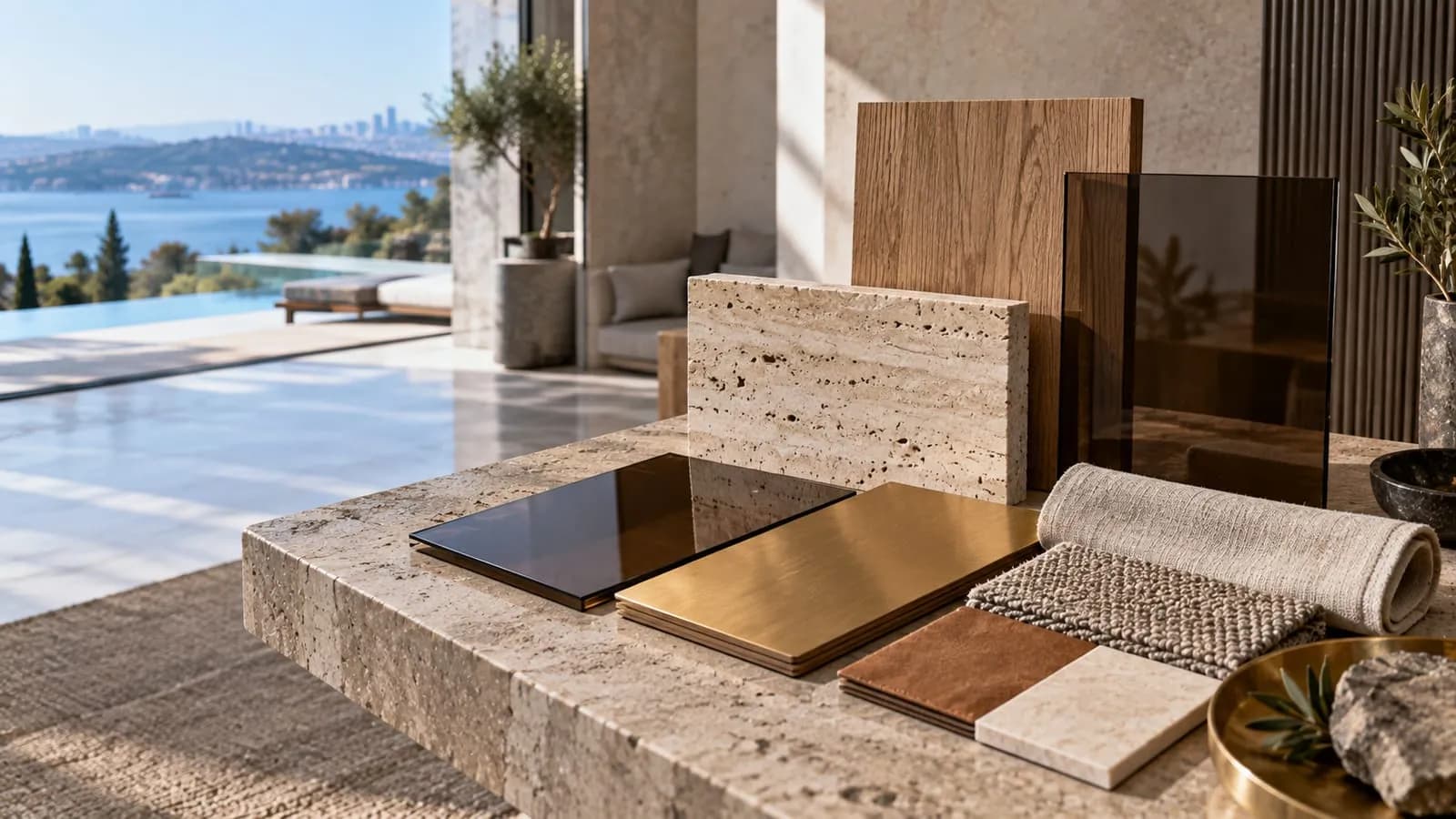
Natural stone or fibre cement, solid parquet or porcelain, underfloor heating or air conditioning? In a villa, every material choice depends on the climate, maintenance and how the house is used.
Choosing materials in villa construction is more than ticking the product you liked in a catalogue. The same travertine can stay sound for years on a mild coastal plot and start to flake on a hillside with freezing winters; solid oak flooring can open up at the joints in a living room with underfloor heating. Weigh four things together for every item: the climate and the conditions of the plot, how much time you will give to maintenance, how the house will be used (all year round, as a summer home, with children) and the product's documentation.
The structural materials are not on this list. The concrete class and the reinforcing steel are set by the structural calculation, which is based on the soil investigation, and are specified in the design. Your decision is at the level of the system: reinforced concrete, steel or prefabricated.
How do you choose the façade material?
The first decision concerns the system: will the cladding be bonded to the wall, or hung on a subframe with an air gap behind it? In a ventilated (rainscreen) façade, it is the insulation boards fixed to the wall that keep the heat in, not the cladding; the gap carries moisture away and helps the insulation stay dry.
- Render and paint over external wall insulation (ETICS) is the most common solution and the one whose budget is easiest to control. It is sensitive to impact and needs repainting over time. Very dark colours increase thermal stress on the insulation, so ask the system manufacturer for its colour limits.
- Among natural stones, dense types with low water absorption, such as basalt, are the safer choice in a freezing climate. Travertine, limestone and some andesites are porous; in a cold region their frost resistance should be confirmed by a test report. Polished marble loses its shine outdoors over time. Large, heavy slabs must be hung on stainless steel anchors; mortar alone cannot be relied on.
- Timber (iroko, teak, cedar, thermally modified wood) turns silver-grey in the sun; keeping its colour means oiling it regularly.
- Fibre cement, HPL and ceramic façade panels come in a wide range of colours and need little maintenance; they are usually installed as a ventilated system.
The reaction-to-fire class of the insulation and the cladding is stated in the product documents; which class the façade requires is set by the design and by Turkey's Regulation on Fire Protection of Buildings.
Which insulation material goes where for heat, water and sound?
- External walls are most often insulated with stone wool or EPS. Stone wool is non-combustible and vapour-permeable, and it also helps with sound; EPS is lighter and cheaper.
- Surfaces in contact with water, such as foundations, basement retaining walls and flat roof terraces, take XPS, which absorbs little water. Waterproofing is done with a bituminous membrane, covered with a protection board and drainage.
- On a pitched roof, if the loft will not be used, the insulation goes on the top-floor ceiling slab; if the attic is living space, it follows the slope of the roof.
- In bathrooms, on balconies and on terraces, a flexible cementitious waterproofing coat is applied under the finish.
- Impact sound between floors is cut by a floating screed, separated from the slab and the walls by a resilient layer.
Insulation thickness is not picked by habit; it comes from the thermal insulation calculation in the design, according to the climate zone. The class on the Energy Performance Certificate (EKB), issued under Turkey's Regulation on Energy Performance of Buildings, is determined by the insulation, the windows and the heating system together.
Aluminium, PVC or timber windows?
- Thermally broken aluminium suits projects that want slim profiles and large openings; full-height sliding doors and corner glazing are usually done in it. Aluminium without a thermal break condenses in winter.
- PVC insulates well and costs less; for very large sashes and dark colours, the manufacturer's size limits are what decide.
- Timber windows give a warm look inside but need maintenance on the outside face; a system with timber inside and aluminium outside cuts most of that maintenance.
Glass is judged on two things: heat loss in winter and solar gain in summer. A low-E coating reduces the loss; a solar control coating stops overheating on west- and south-facing façades. Shading the sun outside the glass works better, so for large glazed areas, external blinds or a roof overhang should be planned from the start. Floor-to-ceiling glass that acts as a balustrade must be laminated glass, which holds the fragments on its interlayer when it breaks.
Which rooms suit parquet, natural stone or porcelain?
- Solid parquet lasts a long time because it can be sanded again, but it moves with humidity. With underfloor heating, engineered (multi-layer) parquet is the safer choice; its suitability should be stated in the technical data sheet. Laminate flooring is not suitable for wet areas.
- Marble is a frequent choice for living rooms and entrances; it scratches and is dulled by acids such as lemon juice and vinegar. A honed finish or granite shows fewer marks.
- Porcelain tile absorbs very little water and does not stain; it conducts heat well, so it works well with underfloor heating. Large-format slabs mean fewer joints but need a level screed.
In wet and outdoor areas, check the slip resistance class in the data sheet; places walked on barefoot, such as pool surrounds and showers, use a separate classification. If you want no threshold where parquet meets stone, the screed levels have to be set according to the thickness of each finish.
What should you watch for in bathrooms and kitchens?
In the bathroom, the most important decisions end up inside the wall and the screed. A level-access shower needs a drop in the slab for the drain and the floor fall; if this is not planned from the start, either a step appears or the screed of the whole bathroom is raised. With a wall-hung WC, the access opening to the concealed cistern must stay reachable. The body of a concealed mixer stays inside the wall, so choose a product whose spare parts are available; a thermostatic mixer keeps the water temperature steady and lowers the risk of scalding in a home with children or elderly people.
For kitchen worktops, granite is hard and heat-resistant. Quartz composite does not stain, but because of the resin it contains, hot pans cannot be put on it and it is not suitable for a sunny outdoor kitchen. Marble marks with acid; it suits those who accept that patina. Porcelain slab resists heat and stains, though its thin edges are sensitive to knocks. Ask for a moisture-resistant carcass for the under-sink cabinet.
Which heating, cooling and building services system suits whom?
Building services decisions should be made while the shell is going up; once the walls are closed, a route can only be changed by breaking them open. You can see which decision is needed at which stage in our article on the villa construction process.
- Underfloor heating spreads heat evenly and, because it runs on low water temperatures, works well with a heat pump. It warms up and cools down slowly, which is an advantage in a house lived in all the time and a drawback in a summer house opened at weekends; there, fan coil units or air conditioning are more practical.
- A ground-source (geothermal) heat pump needs boreholes or a large pipe field in the garden, so the decision is made together with the landscaping. An air-source heat pump and, where mains gas is available, a condensing boiler take up less space.
- Photovoltaic panels produce electricity and solar thermal collectors produce hot water; for both, the orientation of the roof and its shading are what decide.
- In a smart home, a wired system is pulled in before the walls close, while a wireless one can also be installed later. Whichever you choose, leave empty conduits for cameras, audio and curtain motors.
Seaside, summer home, cold climate: choices that suit each case
| Situation | Choices that tend to work | Watch out for |
|---|---|---|
| By the sea | Stone, ceramic or fibre cement façade; aluminium windows with a surface finish suited to a marine environment | The grade of stainless steel in anchors, balustrades and fixings |
| Region with harsh, frosty winters | Stone with low water absorption, triple glazing, underfloor heating with a heat pump | Frost test report for porous stone; falls and drains on flat roofs |
| Hot, sunny region | Solar control glass, external shading, light-coloured façade, stone or porcelain floors | Large glazing on the west façade |
| Summer home used part of the year | Low-maintenance façade, fast-response heating and cooling, remotely monitored water-leak alarm | Damp in a house left closed |
| Family with children or pets | Matt porcelain, parquet with a hard-wearing lacquer, thermostatic mixers, laminated glass | Polished marble, softwood |
| No time for maintenance | Fibre cement or ceramic façade, aluminium windows, porcelain or quartz worktops | Timber façade that needs oiling |
Have each choice written into the contract with its brand, series, size and grade. We prepare our quotations from a quantity take-off; when the materials are defined in it, it becomes easier to compare two quotations on the same terms. How the material grade affects the budget is covered in our article on villa construction cost, and how the chosen materials are installed and accepted on site in the one on villa workmanship and quality control.
Frequently Asked Questions
What is the most durable material for a villa façade?
It depends on the climate. In a freezing region, dense stone with low water absorption lasts longest; by the sea, stone, ceramic or fibre cement hung on corrosion-resistant anchors.
Can you use parquet with underfloor heating?
Yes; choose an engineered (multi-layer) parquet whose technical data sheet states it is suitable for underfloor heating. Solid parquet moves more with changes in temperature and humidity, so the risk of open joints is higher.
Should I choose locally made or imported materials?
Do not compare by country of origin. Look at the product's CE marking or its certificate of conformity to the relevant TS EN standard (the Turkish adoption of the European standard), its technical data sheet and the availability of spare parts and service; between two fully documented products, choose the one whose service you can reach more easily.
Where to go next
Next steps on the villa and residential side:

By
Serdar Savaş · Founder and Chairman
In the construction industry since 1989; founded Savaş Grup A.Ş. in 1998. Has led 30 factory, hotel, residential and wellness projects in 6 countries. Writes on the urban-transformation contracting model and international project partnerships.
Get a quote for this service
Fill in the form for a free survey and a transparent, quantity-based proposal; we reply within one business day.