
Residential & Villa
How to Check Material and Workmanship Quality in Villa Construction
Even with the right materials, problems usually appear during installation. Which details in a villa are checked, at what stage and with which test?
Even in a villa built with the right materials, a terrace can leak, stone cladding can crack and mould can appear around a window. These problems usually start where two materials meet, and they are noticed only after the work has been covered up. How to choose the materials is covered in our article on choosing luxury villa materials; the job after the choice is to see every piece of work before it is covered and to accept it against a written standard.
How is quality defined in the contract?
Writing "first-class workmanship" into a villa construction contract is no help in a dispute. Materials should be defined by brand, series and grade, and the installation by detail drawings. If points such as window junctions, terrace drains and shower outlets are not drawn in the design, the tradespeople on site will solve them their own way.
The second tool is the sample room. Before the finishes start, one bathroom or room is completed in full; joint widths, cuts, corners and silicone joints are approved there, and the remaining rooms are built to that standard. When payment is made through progress payments, it also becomes easy to make an item's inclusion in a payment conditional on a signed inspection record.
Where do installation errors show up most often?
Waterproofing
On foundations and basement walls, the membrane's overlaps, corner returns and pipe penetrations are checked one by one; if the backfill goes in before the protection board, stones in the fill puncture the membrane. On terraces, balconies and in wet rooms, the weak points are where the waterproofing turns up the wall and where it meets drains and outlets. Garden and terrace levels should fall away from the building so that water is carried off.
Window installation
Fixing a window with polyurethane foam alone is a common mistake: the foam breaks down in sunlight and lets water through. The gap between the frame and the wall should be sealed with a vapour-barrier tape on the inside and, on the outside, a tape that keeps water out but lets vapour through. The external sill should slope outwards and have waterproofing under it. If the window is fitted out of line with the insulation layer, a thermal bridge forms around it; this is a common cause of mould at window reveals.
Façade and floor finishes
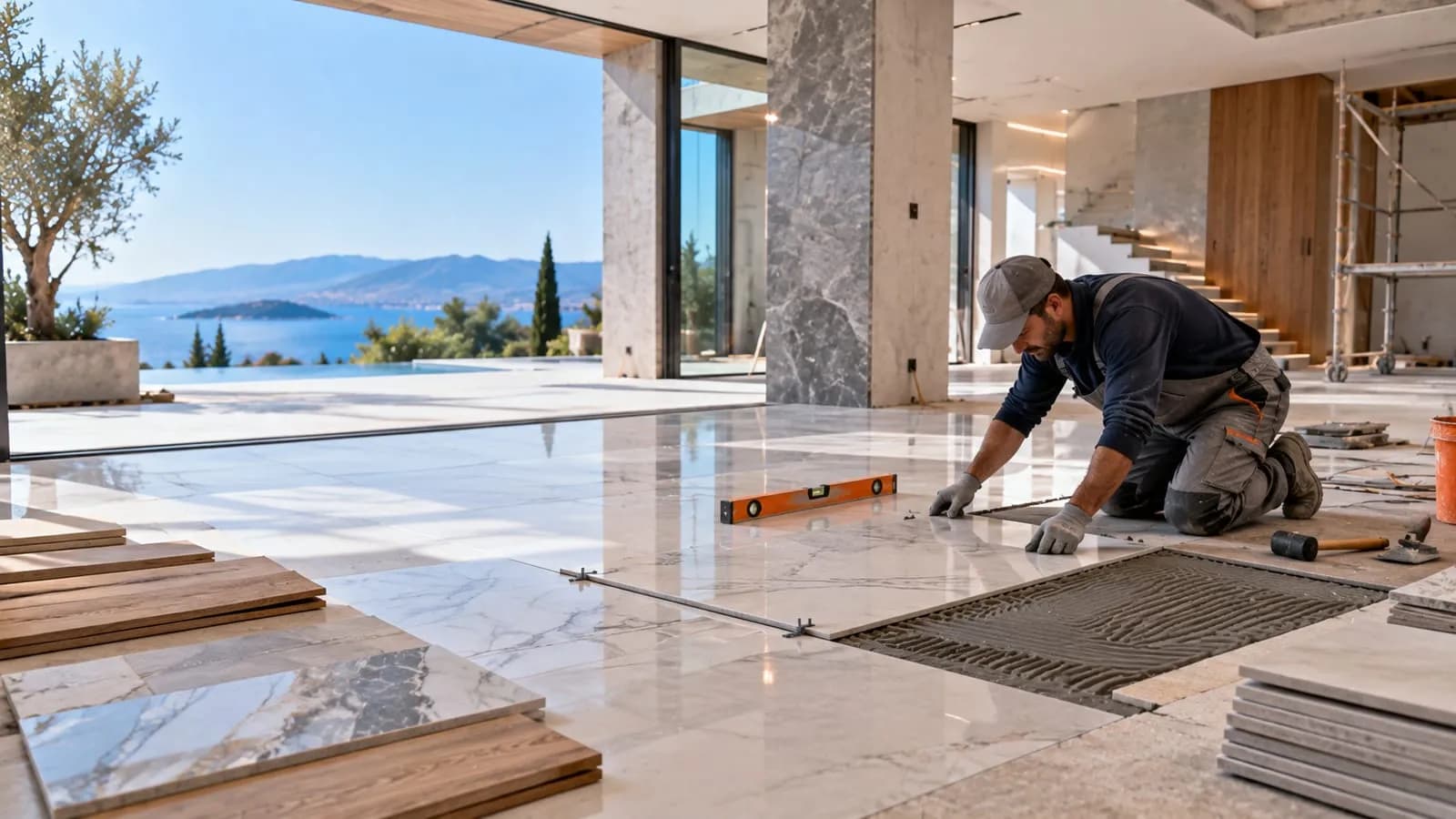
On external wall insulation, if diagonal mesh reinforcement is not added at the window corners, cracks start from the corners. On a stone façade, check that the anchors are stainless steel before the cladding covers them. Large-format porcelain is laid with no voids by spreading adhesive on both the tile and the floor; a tile laid with voids sounds hollow underfoot and can crack over time. Parquet is not laid before the screed moisture is measured, and a screed with underfloor heating is dried with a heating programme before the floor finish goes down.
Building services
Water and heating pipes are pressure-tested before they disappear under plaster or screed; with underfloor heating, the screed is poured while the pipes are under pressure. On the drainage, the falls and cleanout access are checked; on the electrics, cable sizes and earthing. Low-voltage and smart home cabling should be labelled.
Who checks what on site?
At every stage of the villa construction process, inspection works on three levels:
- The building inspection firm, as required by Law No. 4708 on Building Inspection, checks that the building complies with the approved design and the regulations: it inspects the reinforcement before concrete is poured, has concrete samples taken and also monitors the building services. In a steel or prefabricated villa, the same check covers welds, bolts and connection details. Ask for copies of these records.
- The contractor's site manager should accept each piece of work before the next one starts: the waterproofing before the finish, the services before the plaster, the screed before the parquet.
- Matters governed by the specification, such as straight joints and colour and shade matching, are followed by the client; if you cannot visit the site regularly, an inspection engineer or architect can do this on your behalf.
When materials arrive on site, they are checked against the delivery note, the product documents and the approved sample. Tiles and stone for the same room should come from the same batch and shade code; a difference only shows once they are laid. Keep a photograph, with measurements, of every piece of work that will be covered; it is the easiest way to find a pipe later.
Which tests should a villa pass at handover?
Alongside the visual inspection, check that the following tests have been carried out and recorded:
- a flood test on terraces, balconies, wet rooms and the pool before the finishes go on,
- a pressure test on the plumbing and heating,
- earthing and leakage current (RCD) tests on the electrics,
- an opening, closing and gasket check on the windows, with a hose test on any doubtful joint,
- a thermal camera scan for thermal bridges, if handover falls in the heating season.
Defects are listed room by room, and each item is signed off as it is closed. The handover file should contain the as-built drawings, photographs of the services, product documents and maintenance instructions. The occupancy permit (iskan) requires a report from the building inspection firm.
Frequently Asked Questions
How can I tell good workmanship?
Look less at the finished surface than at the stage before it was closed: waterproofing upstands, test records, photographs of the services. In finished work, straight joint lines, cuts placed where they do not catch the eye and doors and windows that open without forcing are good signs.
Does the building inspection firm also check the finishes?
Building inspection focuses on compliance with the approved design and the regulations; the structure and the building services are at its centre. Straight joints, shade matching or paint quality fall under the specification in the contract and should be followed by the client.
Do I need an independent inspection engineer?
It is not mandatory. If you cannot visit the site regularly, an inspection engineer or architect who signs off work on your behalf before it is covered can catch problems while they are still visible.
Where to go next
Next steps on the villa and residential side:

By
Serdar Savaş · Founder and Chairman
In the construction industry since 1989; founded Savaş Grup A.Ş. in 1998. Has led 30 factory, hotel, residential and wellness projects in 6 countries. Writes on the urban-transformation contracting model and international project partnerships.
Get a quote for this service
Fill in the form for a free survey and a transparent, quantity-based proposal; we reply within one business day.