
Urban Transformation
Flat-for-Land or Construction Contracting in Urban Renewal?
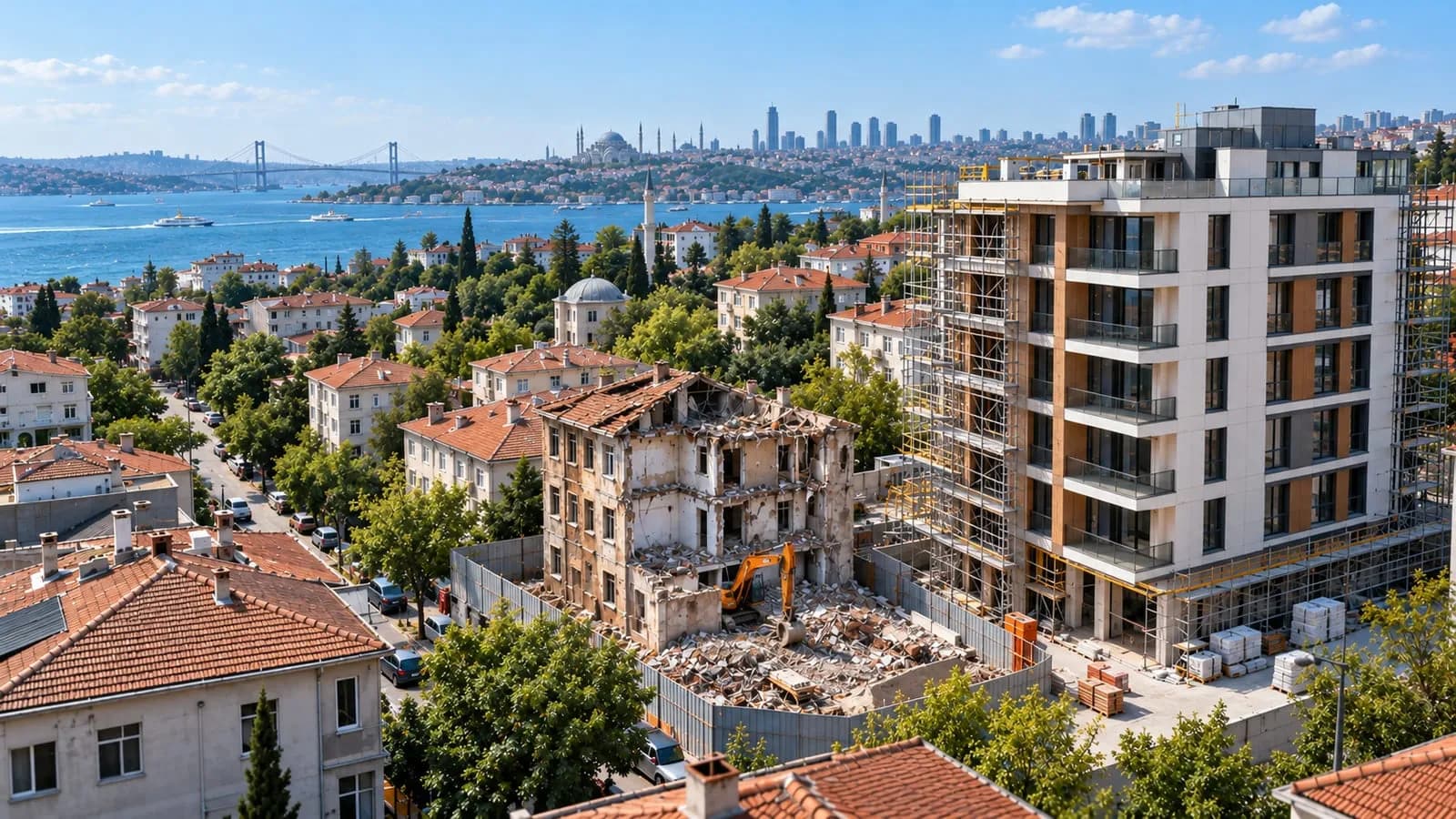
With flat-for-land, some flats and their land share go to the contractor; with the contracting model, all stay with the owners, who pay in progress payments. Which suits your building?
Short answer: Under flat-for-land, the flat owners hand some of the flats in the new building, together with the land share attached to them, to the contractor, and the contractor pays for the construction. Under the construction contracting model, the owners keep the land share and every flat; they pay the construction price as the work advances, through progress payments. The first needs no cash but costs you flats and decision-making power. The second takes financing and follow-up, and in return the design and material decisions stay with the owners.
Which one pays off better varies from building to building. Three things decide it: how much additional floor area the zoning status gives the new building, the value of the land, and whether the owners can cover the construction price.
Who keeps the land share?
A flat-for-land construction contract lists, one by one, the units to be handed to the contractor and the land shares attached to them. Because the contract contains a promise to transfer real estate, it has to be drawn up by a notary as an official deed. The title transfer is usually tied to construction progress: no share changes hands until the work reaches a set stage. If the contractor abandons the job halfway, this staged-transfer clause is the owners' main protection.
Under the construction contracting model, there is no share to transfer. The owners remain the owners of the building; the contract with the contractor is a works contract (eser sözleşmesi in Turkish law), and the contractor is entitled to the price of the work it carries out. When construction is finished, all the flats and shops are registered under condominium ownership (kat mülkiyeti) in the names of the existing owners. If the zoning allows more floor area than the existing building has, the additional flats also belong to the owners; selling them can cover part of the construction price.
How do cost and progress payments work?
Under flat-for-land the cost is invisible: the market value of the flats handed to the contractor is what you actually pay for the construction. Under the contracting model the cost is out in the open. The quantity take-off from the design is multiplied by unit prices, and the quotation can be read line by line. In Savaş Grup's urban renewal service, the quotation is based on a quantity take-off in exactly this way and is free of charge; for the official unit costs, see our article on 2026 construction cost per square metre.
Payment is made through progress payments. At intervals set in the contract, the work done is measured on site, a progress payment statement is drawn up, the owners' representatives approve it, and only the work done in that period is paid for. This way, the money the owners hand to the contractor stays limited to work actually carried out on site. To check the measurements, the owners can hire an independent control engineer. The building inspection firm checks, under Law No. 4708 on Building Inspection, that the building complies with the design and the regulations; payment calculations are outside the scope of that inspection.
Under this model, the owners carry part of the cost risk. The contract should state clearly:
- which index will be used to update unit prices if material and labour prices rise (price adjustment),
- the guarantee the contractor provides and the retention deducted from progress payments,
- the delay penalty and the termination conditions if the work programme is not kept,
- the items not included in the quotation: design, permit fees, the building inspection fee, demolition, utility connections and occupancy permit costs.
Who decides what, and when?
| Decision | Flat-for-land | Construction contracting |
|---|---|---|
| Architectural design and flat layouts | Negotiated before the contract; afterwards largely up to the contractor | Owners, throughout the project |
| Materials and brands | Only as far as the specification attached to the contract goes; anything not written down is the contractor's choice | Owners; the specification is an annex to the contract |
| Land share transfer | For the contractor's flats, as construction progresses | None |
| Payment | No cash; the price is paid in flats | At each progress payment period, for the work done |
| Cost increases | As a rule, borne by the contractor | Depends on the price-adjustment clause; mostly borne by the owners |
| Sale of flats | The contractor sells its own share | The owners sell or keep the additional flats |
Keeping the decisions with the owners only works if the owners are able to make them. If the flat owners' assembly does not authorise a small committee of representatives for design approval, site decisions and progress payment approval, every decision waits for a meeting and the site slows down. What to check in materials, insulation and common areas is gathered in our article on building to last in urban renewal.
Which model suits which building?
Flat-for-land usually works for buildings where the zoning gives the new building clearly more floor area, the land value is high, and the flats that fall to the contractor's share cover the construction price. It is also the easier route for owners who do not want to use cash or loans, or who cannot spare the time to follow the site.
The construction contracting model comes to the fore when:
- The zoning gives no extra floor area, or very little; contractors do not offer flat-for-land at all, or offer the owners smaller flats.
- The owners want to keep the number of flats and their floor areas.
- The construction price can be covered from savings, loans or public support. In Istanbul, the "Half on Us" (Yarısı Bizden) campaign gives owners who demolish and rebuild their at-risk building a grant, a loan and relocation support; the "Half on Us" calculator shows the total for your building.
- There are few owners and decisions are easy to reach.
A common problem under the contracting model is the gap in ability to pay between owners: an owner who cannot pay their share holds up the flow of progress payments. In such buildings the two models can be combined: some of the flats created by the additional floor area go to the contractor, and the rest of the price is paid in cash. Where to strike that balance is, again, worked out from the quantity take-off, using the building's own figures.
How does the process run, step by step?
- A licensed institution examines the building; the at-risk building report is approved under Law No. 6306 on the Transformation of Areas under Disaster Risk by the provincial directorate of the Ministry of Environment, Urbanisation and Climate Change.
- Based on the zoning status issued by the municipality, the floor area and number of flats of the new building are worked out. The two models cannot be compared without this figure.
- The flat owners decide on demolition and reconstruction, choose the model and authorise the committee of representatives.
- A soil investigation is carried out; the architectural, structural and building services designs are prepared, together with the material list and the technical specification.
- A quantity-based quotation is obtained on the basis of the design and the contract is signed: unit prices, work programme, progress payment periods, price adjustment, guarantee and delay clauses.
- Loan and support applications are made; conditions vary by city.
- The building permit is obtained, and the building is vacated and demolished.
- Construction proceeds under the supervision of the building inspection firm, period by period with progress payments.
- The occupancy permit is obtained, condominium ownership is established and the flats are handed over.
City Guides (September 2026)
Support and procedures differ from city to city: Istanbul urban renewal (with the "Half on Us" support), strengthen or rebuild in Ankara and the "İzmir Renews" programme.

By
Serdar Savaş · Founder and Chairman
In the construction industry since 1989; founded Savaş Grup A.Ş. in 1998. Has led 30 factory, hotel, residential and wellness projects in 6 countries. Writes on the urban-transformation contracting model and international project partnerships.
Get a quote for this service
Fill in the form for a free survey and a transparent, quantity-based proposal; we reply within one business day.