
Urban Transformation
İzmir Urban Renewal 2026: "İzmir Renews" and the Ground Reality
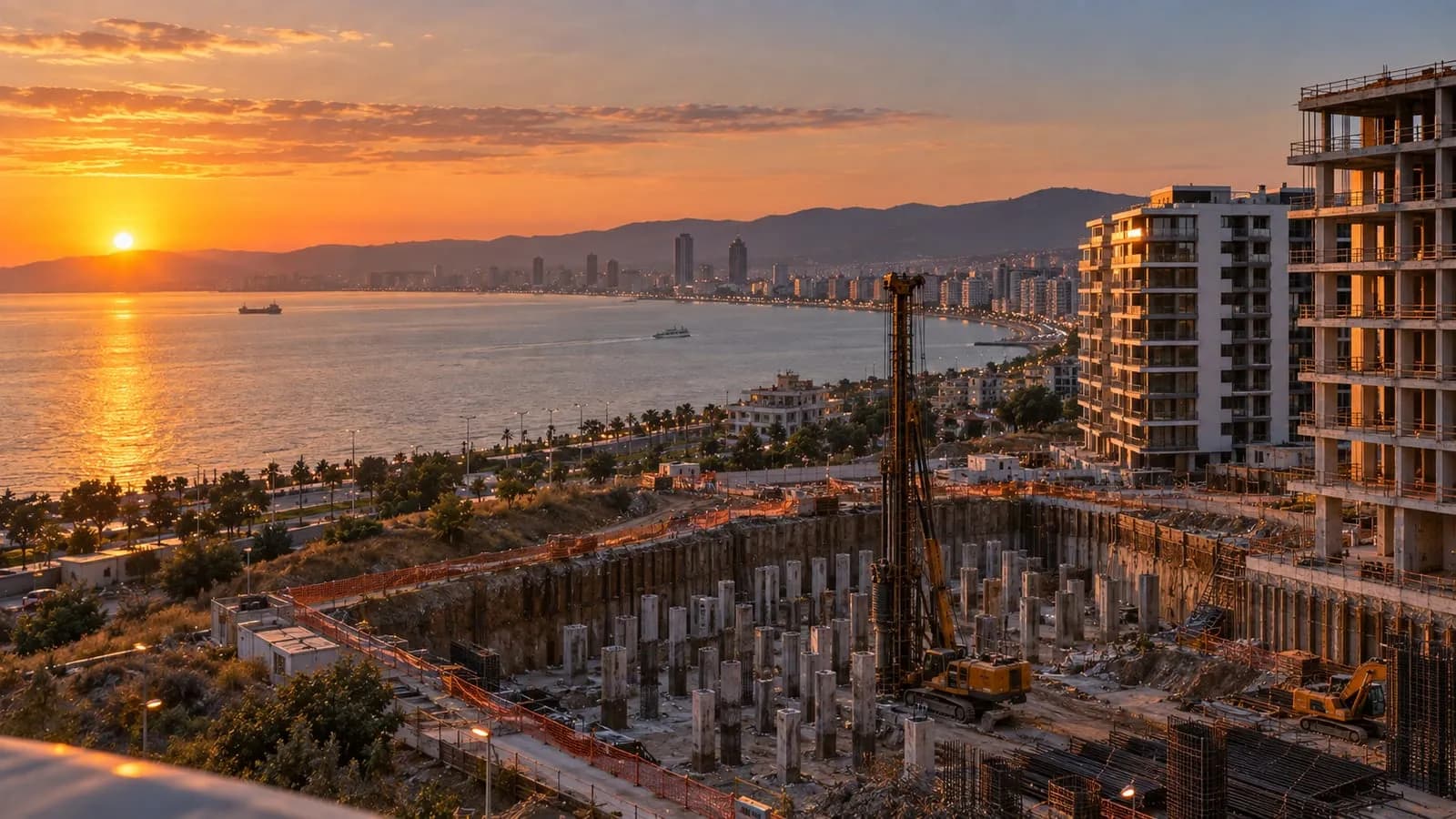
A 96,000-building preliminary survey, 180,000 very-high-risk structures and the Bayraklı–Bornova pilot: six years after the 2020 earthquake, how is urban renewal moving in İzmir and what should owners do?
The Samos earthquake of 30 October 2020 showed everyone in İzmir what ground conditions mean: buildings in Bayraklı, 70 km from the epicentre, collapsed because they stood on alluvial fill. Six years later, in September 2026, the picture is this: the "İzmir Renews" programme run by the Ministry and the İzmir Metropolitan Municipality has declared Bayraklı and Bornova pilot areas, about 96,000 buildings passed a preliminary inspection by February 2026, and university-led screening put 180,000 buildings city-wide in the very-high-risk group. In Karşıyaka alone 22,500 buildings are on the inspection list.
This guide explains where renewal is accelerating in İzmir, how ground conditions shape the project, what support applies in 2026 and the steps owners should follow.
"İzmir Renews": Pilot Areas and Goal
- Bayraklı (Manavkuyu, Mansuroğlu, Adalet) — the heaviest damage in 2020; dense apartment fabric on alluvial ground. A 10-year renewal timeline is being discussed for the district.
- Bornova (Kazımdirik, Erzene, Atatürk neighbourhoods) — same ground basin as Bayraklı; 1990s cooperative estates.
- Karşıyaka, Konak, Buca — the second wave: dense 1975–1999 stock; 22,500 buildings listed in Karşıyaka.
The programme's logic: the municipality handles block-level planning and infrastructure, the Ministry provides loans and rent support, and owners choose the contractor among themselves. In İzmir, therefore, the weight of urban renewal rests largely on the owners' assembly.
The Ground Reality: Liquefaction and Foundation Design
The İzmir Bay area — especially the Bayraklı–Bornova plain and the Karşıyaka shore — carries liquefaction risk due to thick alluvium and a high water table. This forces three decisions in any rebuild:
- Plot-specific soil survey — boreholes, SPT and CPT; the neighbour's report is not enough.
- Deep foundations or ground improvement — piles, jet-grout or stone columns; adds 8–15% to the shell budget but determines the building's life.
- Storeys and stiffness — soft storeys and irregular plans must be avoided on weak ground; a high shear-wall ratio and a symmetric structure are preferred.
This is why the per-m² cost in İzmir can come out somewhat higher than an Istanbul project of the same finish level.
2026 Support in İzmir
| Support | 2026 condition |
|---|---|
| Rent (relocation) support | TRY 15,000–17,000 per month, up to 18 months |
| Construction and strengthening loans | With Ministry interest support, per-unit cap |
| Municipal support | Infrastructure, planning and fast-track permits in pilot areas; project offices |
| Fee exemptions | Title-deed, notary and stamp-duty exemptions |
The grant-heavy "Half on Us" campaign applies only in Istanbul; see our Istanbul urban renewal 2026 guide, and use the "Half on Us" calculator for a building in Istanbul. Because financing in İzmir rests on loans plus owner contributions, the construction-contracting model — building at a fixed price without giving units to a developer — matters even more.
Cost and Time: The September 2026 Picture
TurkStat's July 2026 Construction Cost Index rose 28.33% year on year; labour 30.51%, materials 27.13%. In İzmir, the ground-improvement item pushes the budget somewhat above an Istanbul project of the same finish level. Cement prices rose about 50% and rebar 10% in the first half of the year, adding to the cost of waiting.
What to Require in New Housing in İzmir
- Performance target per the 2018 Turkish Seismic Code; C30+ concrete, ductile detailing.
- Foundation report and foundation type based on the soil survey.
- Corrosion measures for the marine environment: concrete cover, epoxy-coated rebar options.
- Energy performance certificate class B or better; solar infrastructure for the İzmir climate.
- Independent building inspection and progress-based payments.
Our residential construction service defines these criteria as a contract annex, and the Savaş Grup urban renewal team manages everything from risk assessment to turnkey delivery under one roof.
Step by Step for Owners
- Obtain the municipality's preliminary inspection result; get a risk report from a licensed institution.
- Decide on demolition and rebuild by simple majority at the owners' assembly.
- Soil survey and architectural-structural design; district permit (fast-tracked in pilot areas).
- Loan and rent-support applications (İzmir Provincial Directorate).
- Demolition (1 month) and construction (14–20 months including ground improvement).
- Occupancy permit, title update, handover.
From the Earthquake Zone to İzmir
The reconstruction programmes in Kahramanmaraş, Hatay and Malatya after the 2023 earthquakes became a live laboratory for fast, safe construction on weak ground; our article on reconstruction in the earthquake zone explains how those lessons carry over to cities like İzmir.
Urban Renewal in İzmir with Savaş Grup
For buildings in Bayraklı, Bornova and Karşıyaka we brief owners' meetings free of charge, prepare a pre-feasibility including the soil survey and sign at a fixed price per square metre. Share your building's preliminary inspection result and request a quotation.

By
Serdar Savaş · Founder and Chairman
In the construction industry since 1989; founded Savaş Grup A.Ş. in 1998. Has led 350+ factory, hotel, residential and wellness projects in 22 countries. Writes on the urban-transformation contracting model and international project partnerships.
Frequently Asked Questions
01How do I apply to the "İzmir Renews" programme?
02How many storeys can be built on liquefaction-prone ground?
03How long does urban renewal take in İzmir?
04Is there rent support and a loan facility in İzmir?
Get a quote for this service
Fill in the form for a free survey and a transparent, quantity-based proposal; we reply within 24 hours.