
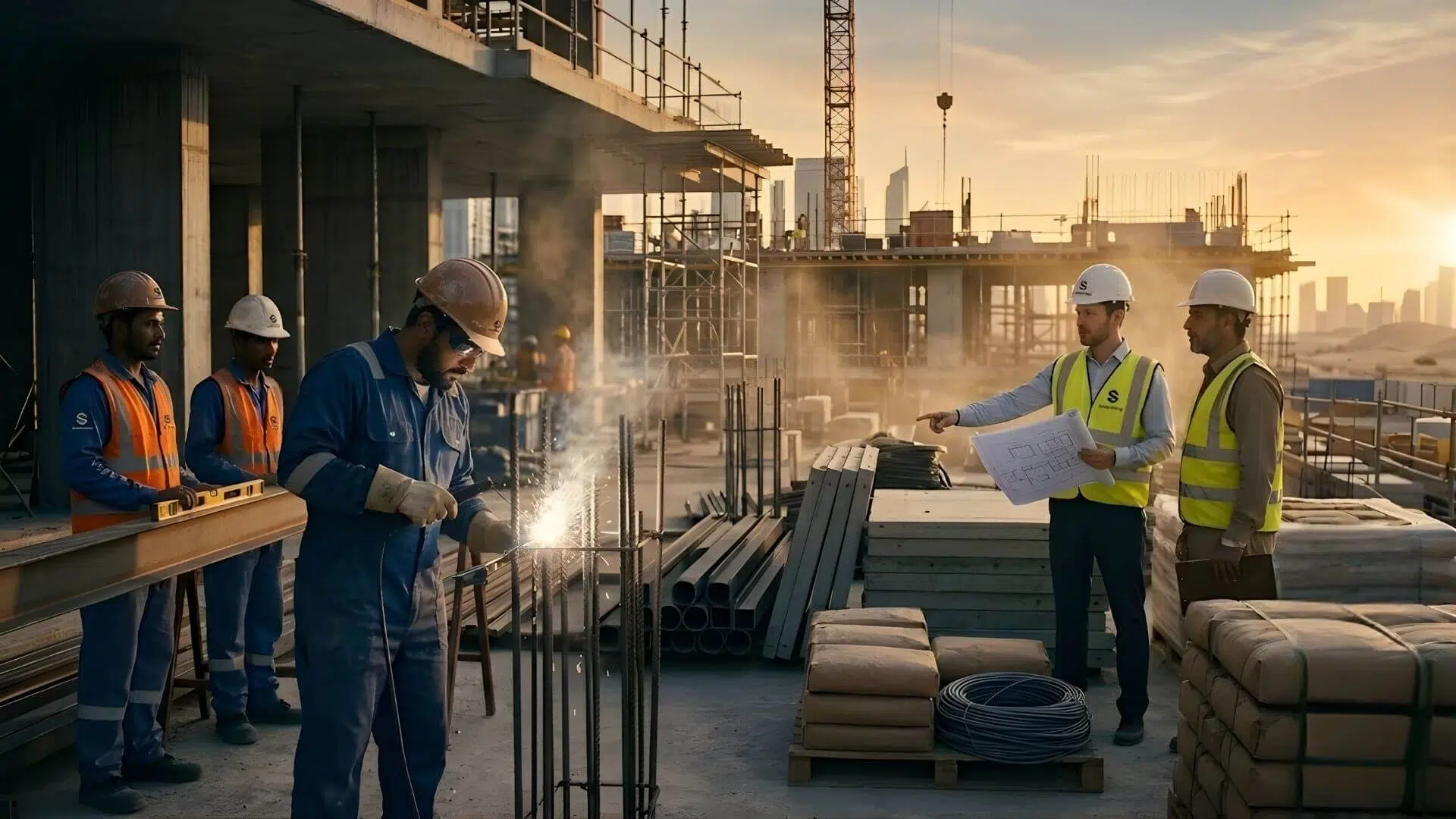
The Middle East is attracting attention with rapidly growing construction investments in countries such as Saudi Arabia, the United Arab Emirates (Dubai and Abu Dhabi), Qatar, Kuwait, Oman, Bahrain, Iraq, Jordan, and Algeria. Mega city projects, luxury residential investments, tourism facilities, and industrial structures offer significant opportunities for investors.
The issues that investors care about most in this market are cost control, quality assurance, and timely delivery. The “materials from you, labor from us” model offers a balanced and strategic business approach that meets these fundamental needs.
The construction sector in the Middle East is growing rapidly, and investors always want to optimize their costs. For this reason, the “materials from you, labor from us” model has become a preferred method, especially for large projects.
The Dynamics of the Middle East Construction Market
Middle Eastern countries are allocating significant budgets to urbanization and infrastructure investments as part of their economic vision projects. Saudi Arabia’s mega city projects, the UAE’s luxury residential and commercial tower investments, Qatar’s hotel and mixed-use projects, and Iraq’s reconstruction process are increasing the region’s construction volume.
Başarılı olabilmek için yalnızca sermaye yeterli değildir; teknik planlama, uygulama kalitesi ve saha organizasyonu belirleyici faktörlerdir.
Since construction projects in the region are large-scale and complex in nature, coordination with experienced teams at every stage is crucial. Therefore, investors are seeking reliable solutions for material supply and workmanship quality.
What is the Material from You, Labor from Us Model?
In this model, the division of responsibilities is clear. The investor procures the construction materials to be used in the project through their own supply chain. The application, installation, technical supervision, and site organization are carried out by a professional team.
This approach provides the investor with purchasing flexibility while allowing the quality of implementation to be entrusted to expert teams. It also offers the investor significant advantages in terms of cost control and project scheduling.
This model is preferred especially in high-cost and complex projects such as those in the Middle East. In large projects, the timely supply of high-quality materials is critical. Labor, when carried out by professional teams, ensures the project is completed successfully.
Advantages of the Model by Country
| Country | Featured Projects | Contribution of the Model |
|---|---|---|
| Saudi Arabia | Mega city and tourism | Cost control in large budgets |
| UAE (Dubai/Abu Dhabi) | Luxury residential and commercial towers | Global materials + professional application |
| Qatar | Hotels and mixed-use projects | Fast delivery and quality assurance |
| Iraq | Housing and infrastructure | Flexible budget management |
| Kuwait | Villa projects | Controlled field organization |
| Oman | Resort investments | Long-lasting structural quality |
| Bahrain | Commercial projects | Technical implementation in accordance with standards |
| Algeria | Public housing | Local material advantage |
| Jordan | Public projects | Process and quality discipline |
The model’s contributions vary by country, but the fundamental advantages always focus on cost control, on-time delivery, and high quality.
Project Process Management
Process management is critical for a successful implementation. The model typically progresses through four key stages.
1. Preliminary Analysis and Planning
The scope of the project is defined, the material list is checked, and the technical requirements are clarified. A timeline is created to ensure budget compliance.
2. Technical Organization
Application drawings are prepared, the field team is planned, and logistics coordination is carried out. This stage lays the foundation for the smooth progress of the project.
3. Implementation Process
The construction site setup is completed and field applications begin. Daily inspections, quality controls, and work safety procedures are implemented regularly.
4. Delivery and Final Inspection
Final quality tests are performed, technical approval processes are completed, and the project is delivered with any deficiencies addressed.
Throughout these stages, cost optimization, time management, and quality control are continuously applied.
Frequently Asked Questions (FAQ)
How is material quality guaranteed?
Technical suitability checks are carried out prior to application; non-standard products are not used on site.
Is it applicable in large-scale projects?
Yes, it offers advantages in terms of cost control and project management, particularly in mega projects.
Is it suitable for small projects?
It can also be easily applied in villas and boutique projects.
In which countries is it more common?
It is widely practised in Gulf countries, particularly Saudi Arabia, the UAE, Qatar and Iraq.
Will the delivery time be extended?
Delivery times are kept under control thanks to proper planning and professional site management.
Advantages and Strategies of Projects in the Middle East
For investors in the region, this model offers cost optimisation, time savings and high quality all in one. The “materials from you, labour from us” approach provides flexibility in projects and minimises risks.
For large-scale construction projects, this model provides a high level of control in project management and is advantageous for both investors and work crews. Especially in rapidly growing markets such as the Middle East, proper material and labour management is of critical importance.
Launch your projects with confidence with Savaş Group and get a quote now to control costs and quality.


